

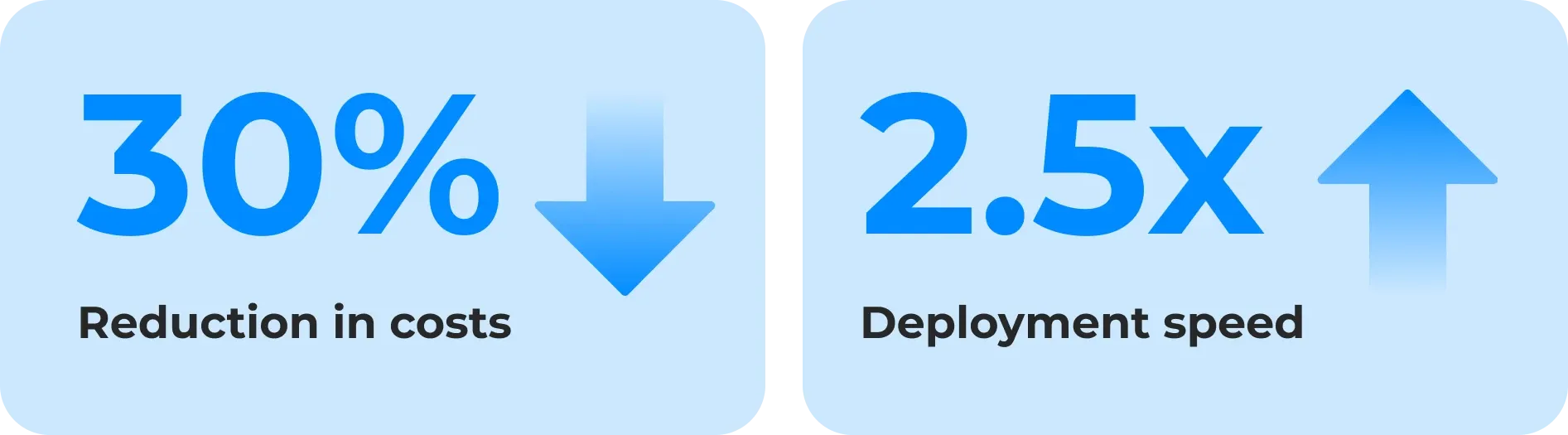
Our AWS offerings are designed to simplify your digital transformation with secure and scalable solutions, supporting innovation and operational efficiency in life sciences. Our experts deliver seamless migration to AWS, develop cloud-native solutions using AWS services and integrate AI/ML to generate insights and automate high-effort work, leading to up to:
As certified AWS consulting partners, we bring a leading team of experts delivering end-to-end AWS services that match the growing demands of life sciences industry.

Guiding life sciences leaders to transition seamlessly to cloud-native AWS environments. Through database migration and application rehosting, we help reduce downtime and simplify migrating to AWS platform. With large-volume data transfers and predictable, repeatable AWS resource setup, we ensure structured and controlled migrations.

Our AWS Development services stand on three pillars: serverless, microservices, and automated delivery on AWS. We use event-driven serverless compute and managed APIs where speed and simplicity are the first priority. For scaling, we leverage container orchestration for microservices and CI/CD workflows for automated builds and releases.

We leverage the platform’s AI/ML services to help integrate advanced capabilities to drive crucial insights for business growth and automate complex time-consuming processes. This includes building, training, and deploying machine learning models end to end, image/video analysis and intelligent document processing, text-to-speech and speech-to-text conversion.
Step 1: Clarity
Aligning on business goals, tech maturity, and current client infrastructure to confirm AWS migration/optimization requirements, including robust, fault-tolerant architectures and solutions.
Step 2: Architecture
Designing a tailored AWS cloud adoption roadmap with detailed steps covering migration, cloud-native development and/or operational needs.
Step 3: Delivery
Smooth transition of databases, applications and data into a cloud-native AWS environment with provisioning and smooth deployment of resilient, cost-effective architectures.
Step 4: Optimization
Optimizing AWS environments for better performance, security and cost, supported by ongoing management and monitoring.








How digitization in SMB pharma can reshape the industry
In recent years, the pharma industry has witnessed a noticeable rise in the number of small and medium-sized pharma companies (SMBs) in drug development. However, many SMBs face operational issues and competitive pressures which are major roadblocks to showcasing their full potential. Digitalization innovation in SMB pharma could be the answer to some of these issues, as it can help SMBs to achieve not only operational efficiencies but also assist in making informed decisions, better data management, and cost-cutting. In this blog, we will tell you about the various areas where digital innovation in SMB pharma can happen. Drug discovery Drug discovery is a complex process that involves numerous time-consuming steps. It is also one of the major undertakings for pharmaceutical companies which has a low success rate. Technology can help companies to accelerate certain mundane tasks in the drug discovery process, thus helping them to focus on other core activities. So, what are the possibilities for digitalization in the drug discovery process? Deep learning algorithms to predict the molecular properties of chemical compounds. Machine learning helps in decreasing drug failure rates during clinical developmental stages.Neural networks can automate challenging tasks like distinguishing diseased cells from healthy ones.Neural networks are also helpful in predicting the absorption, distribution, metabolism, and excretion (ADME) of molecular compounds.Algorithms can also predict new ideas for molecules that can be useful to treat new diseases. This helps the drugs to reach clinical trials much quicker.Clinical trials The clinical trials process is crucial for a drug to reach the consumer, however, the average dropout rate of a drug from a clinical trial is almost 30%. SMBs can minimize this dropout rate by including technology in the various aspects of clinical trials. Data science and natural language processing can be used to scan huge medical databases and extract useful information to optimize the clinical trial process.Electronic health records (EHRs) have become the new standard that can reduce errors, enhance workflow efficiency, and refine healthcare coordination.Digitalization of the patient's health records made it easy to screen and select accurate patients for the clinical trials.A combination of cloud software and wearable devices helped monitor patient vitals and alert the medical professionals about any anomalies.Specialized applications can decentralize the clinical trial process, which may help in improving patient satisfaction and engagement.Drug Manufacturing Small and medium-sized pharma companies often battle with operational issues such as lower capacity utilization, quality control, and breakdown issues in the plant. Technology can help organizations bridge the gaps and achieve operational excellence in drug manufacturing. Here is how you can do it Internet of Things (IoT) helps in connecting all the stake holders in real-time. This will help SMBs to make sure the high demanded drugs are manufactured at the right time.IoT sensors embedded in the manufacturing units can pave way for predictive analytics.Data analytical tools enable real-time monitoring of critical variables of the production line.Getting real-time data from all the manufacturing equipments provide valuable data for making data-driven decisions to achieve superior quality control.Commercialization Effective commercialization process ensures the drug reaches the right consumers at the right time. The traditional drug marketing process is time taking and is not based on real-time information. Multi-channel marketing automation can provide many consumer touchpoints and deliver personalized marketing messages. You can market your drugs better using technology as below. AI-powered analytical solutions can predict consumer behaviours, this might help the customer representatives to schedule the meeting with the right doctor at the right time and place.Digitalization helps to consolidate all the pharma marketing workflows into one system, which allows anyone in the sales channel to get the full picture.Using analytics, sales representatives can segment doctors and send customized marketing messages.Digital solutions can also help sort, clean, and tabulate the huge marketing data making it easy to get actionable insights.IT Requirements One of the major hindrances for pharma SMBs to adopt digitalization is the lack of IT skills and knowledge. Pharma companies need not spend time and effort learning IT skills, they can partner with IT consulting companies to do the work for them. This way the SMBs can focus more on their core business activities. Here are some IT services that can help. IT service partners can help set up the cloud infrastructure and integrate your legacy systems into it.They would implement some of the best practices of IT when it comes to data management and security.From employee onboarding to exit, the IT services partner can handle all the requirements related to technology.They would also provide support, maintenance, and would also guide you through all your IT requirements. Going forward digital transformation in the pharma industry is going to be the norm. The companies that can adapt to these changing circumstances will have an edge over others on the market. With new diseases coming up, the pharma industry is under a lot of pressure to create affordable drugs with a quick turnaround time. However, the pharma industry is also one of the few industries that is governed by stringent rules and regulations. Digitalization can also help SMBs to stay compliant with the regulations while achieving operational excellence and a good turnover rate. Need for information on SMB pharma digitalization? Connect with us.

Top Pharma IT solution trends you should practice - i2e Consulting
The end of last century witnessed Industrial revolution 3 popularly known as the digital revolution and now industries are gearing for industrial revolution 4.0 or IR 4.0 For those who are not aware of this, Technology writer, Alasdair Gilchrist, describes Industry 4.0 as the convergence of people, physical systems, and data within an industrial process to increase quality, productivity and profit by using the power of advanced data analytics. IR 4.0 We know the pace of technology adoption isn’t the strong point of pharmaceuticals. High compliance and regulatory guidelines coupled with the high cost of maintenance make them reluctant to move from legacy systems. However, the adoption of IR 4.0 is different in the sense that it will revolutionize the way we interact with data. We will be armed with technology that will move past unstructured, dispersed and incomplete data. Predictive big data analysis will bring newer insights that are currently in a nascent stage. It’s about time pharma companies jump into the revolution wagon and make themselves future-ready because it is the only sustainable solution. Digital Transformation First things first, is your organization digitally transformed? If not, I would highly recommend you consult some Pharma IT solution providers and have a clear estimate of the current technology stack and commercial viability for the transformation. Without Digital transformation is impossible to leap to IR 4.0. You need to look for efficient migration of your data to the cloud and bridge the gap. Once you are in the cloud you can gradually transition into the latest technologies. Today we will discuss a few pharma IT technologies that are trending and IR 4.0 ready. Pharma IT trends RPA: Robotic Process Automation (RPA) is the technology that enables us to configure computer software, or a ‘robot’ to emulate and integrate the actions of a human interacting within digital systems to execute a business process. RPA has several used cases from Clinical development to supply chain management. It is also being used to enhance precision marketing and salesforce operations. Cloud computing: Cloud computing can facilitate faster innovation, leaner innovation and streamline processes. AI-based drug development in the cloud is now a reality. If you are a Drug Discovery Company, you can avail of cloud-based high-performance computing (HPC). Cloud today offers social listening tools that help understand volunteer experience in clinical trials. Cloud can help companies come together to share a common platform while keeping independent data secured. However, companies often face customization issues on cloud and stick to on-premise infrastructure, as a result, they are not able to take advantage of cloud computing. If you wish you harness the power of cloud computing migrating to the cloud is imperative. Augmented Reality: Augmented, virtual or mixed reality is being actively used by fortune 50 companies. Though Pharma/healthcare sector is not particularly good at breaking the ice, yet there have been many cases where they are using such technologies to get better insights. AR/VR is highly engaging, informative and unique (well for now it is) which makes it ideal for medical education, healthcare provisions, and pharma marketing. The day is not far when such technology will become an industry standard. Interoperability: Blockchain has been around for some time now and the hype surrounding it as the next big thing is insane; however, it is not until recently, that the pharmaceutical industry has begun to leverage the power of blockchain. It offers immutable records while maintaining data privacy, which can help achieve interoperability in its true sense by creating an end-to-end trust network in the supply chain. Simulation: Pharma industry is undergoing massive change. This together with the ever-increasing cost of operations has made them turn to discrete event simulation. This helps broaden R&D strategies, save time and money on compliance, improves process controls and optimize production. Everything is done in a save the offline environment and you can prepare quality documentation for FDA without impacting the operation of the plant. One thing is for sure major disruptions are on the way. The ideal start would be to assess the current technology stack and the commercial viability of the change. If your organization is digital, then the change should cause minimum downtime. In addition, it is a good idea to prepare the people for the change, support and educate them so they can make a smooth transition from the older systems. Last but not least, make sure you have a very clear goal of what you want to achieve. Know where to stop, else you may have a great product with little use for self.

8 ways AWS redshift is optimizing business intelligence in the healthcare and life science industry
With the major advancement of pharmaceutical sectors, the increasing volume of data that is being produced each day, each second needs a dynamic storage system, preferably faster and more secure. And by data here, we mean the years and years of organizational data that is stored in traditional on-premises data warehouses which require a huge investment of time, money, and maintenance. To solve this problem, Amazon has introduced redshift, a cloud-based database for data management, and analytics for large-scale data. AWS has been a trusted technology partner for the healthcare sector globally. The innovative solutions have made businesses gain more value and maximize ROI and with Redshift data warehousing, the pharmaceutical industry is able to address their business problem in a more sophisticated way, let’s see how- Data analytics and BI for powerful insights – AWS Redshift suite allows healthcare professionals to get better data transparency by integrating it to interactive dashboards and making data driven decisions. With powerful decision making comes improved business processes and customer satisfaction.Advanced query accelerator - Due to its compatibility with various database languages, redshift runs queries 10 times faster than other cloud data warehouses. The AWS processors speed up data operations by eliminating unwanted data movement and scaling out space to get capacity to store more research, lab reports, inventory data etc.Easy migration with existing data warehouse - Redshift enables healthcare organizations move their data to cloud quickly and securely. The database migration service is highly reliable and continuously monitors source and destination database. It also supports homogeneous as well as heterogeneous database migration minimizing downtime and cost involved.Cross account and hierarchical data sharing - It allows data sharing across different levels, both inside and outside of an organization enabling users to securely access the data such as patient details, R&D reports, supply chain data, clinical trials and utilize it as per their need. The feature also allows healthcare professionals Collaboration on a larger scale.Better risk assessment with Redshift ML - The feature allows users to create, train and deploy Machine Learning models called Amazon SageMaker models using SQL queries and use this as a risk management and fraud detection option. Health workers can make predictions based on these trained models and make smarter decisions in drug development and patient’s health assessment.Store data in a synchronized manner - Using high performance SQL queries the robust structured and unstructured data are turned into comprehensive and detailed reports which ease the workload of physicians and healthcare professionals. Patients get access to detailed health reports which reduces the need for repetitive tests as well as medical billings.End to End encryption – AWS in pharmaceutical has always been recognized for ensuring integrity and security of data; and AWS redshift employs Encryption depending on the company’s needs. Redshift security features include - Sign-in credentials, Access management, Cluster security groups, Virtual Private Cloud (VPC), Cluster encryption, SSL encryption, Load data encryption, Protection of Data in transit, Column-level access control.Pay as per capacity occupied– Unlike other database warehouses, AWS redshift is more affordable and offers a payment plan on hourly rate. The users can pay for the nodes and clusters that are being used and can pause the cluster to suspend on-demand billing. Redshift also comes with automated configuration, maintenance, backup, monitoring and is also equipped for disaster recovery, which negates the need for having expensive maintenance tools and set up costs. So, we saw how AWS redshift is helping businesses store, analyze, access and monitor the data and make data-driven solutions to accelerate innovation with minimal cost. Businesses across the world are leveraging AWS technology to gain maximum ROI and customer satisfaction. i2e is a certified AWS partner and has the domain expertise and experience in delivering business analytics services in the pharmaceutical industry as well as other IT firms to improve productivity and efficiency. Get in touch with us to know more about AWS Redshift infrastructure.

